
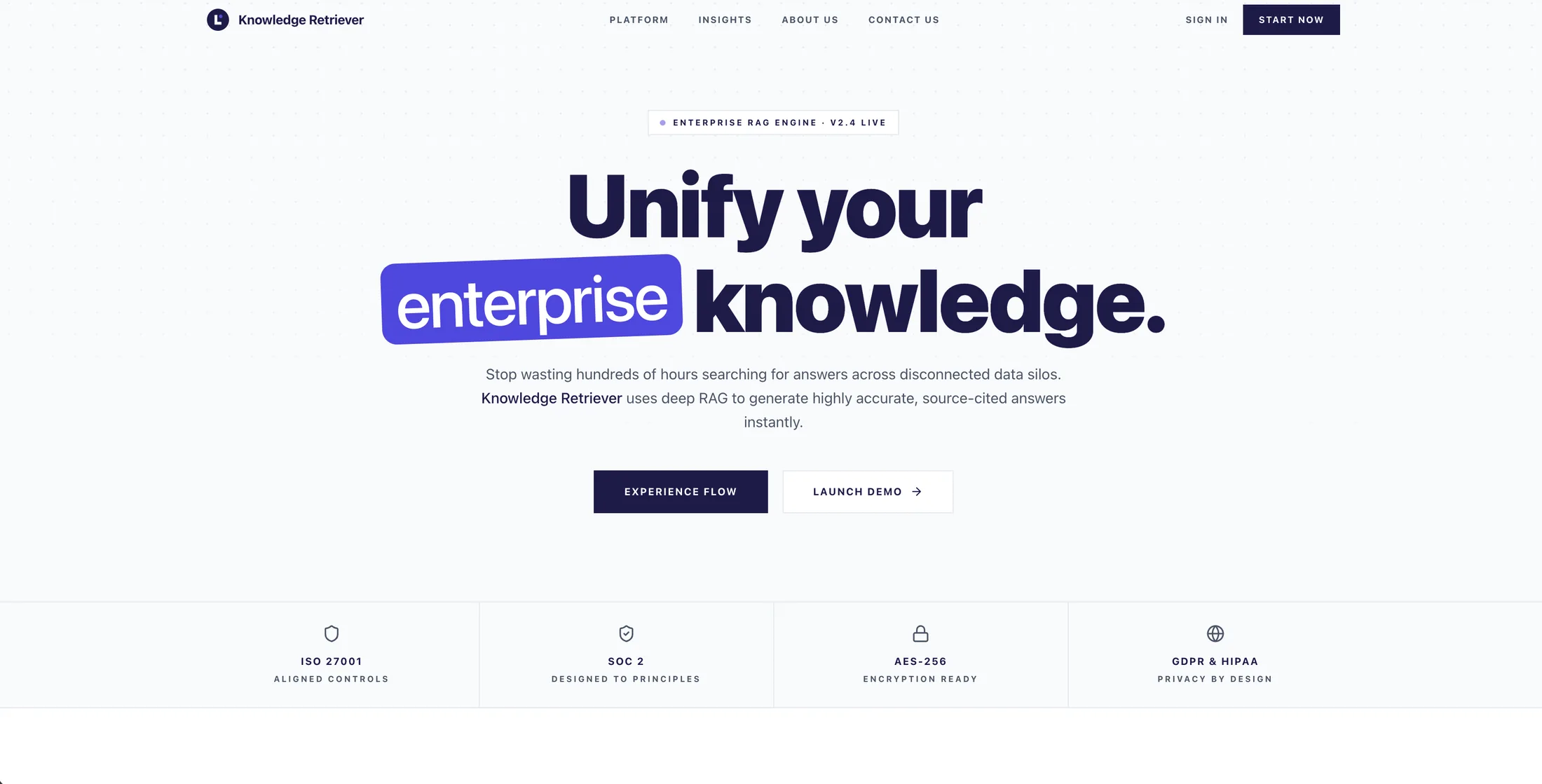
Sharjah portfolio listing · novusengine.stackwise.site · AI & RAG
Novus – Enterprise RAG System
Novus / Knowledge Retriever: enterprise RAG that grounds answers in your docs — portfolio lists ~60% fewer hallucinations*; product page cites 88% faster discovery*
Executive summary
- •Problem: teams lose hours in PDFs/wikis/Slack; generic LLM answers hallucinate without institutional context.
- •Solution: constrained RAG with semantic indexing, parallel synthesis, conflict flags, and source citations.
- •Result: portfolio lists ~60% fewer hallucinations*; product narrative cites 88% faster discovery* and 99.2% retrieval accuracy*.
The business challenge
Institutional knowledge is scattered across Drive, Notion, Jira, PDFs, and chat. Engineers burn bandwidth rediscovering answers. Off-the-shelf chat invents confident wrong answers. The need is trustworthy retrieval with citations — not another AI wrapper.
- •Hours/day lost to search and tribal knowledge
- •Wrong answers in high-stakes engineering/security contexts
- •Onboarding drag for new hires
- •Risk of leaking or misusing proprietary docs in naive LLM setups
Goals & non-goals
Goals
- •Semantic retrieval over institutional corpora
- •Source-cited answers only from retrieved context
- •Explicit refusal when KB lacks an answer
- •Conflict detection for outdated/contradictory docs
- •Tenant-isolated embeddings; no client data for foundation-model training
Non-goals
- •Fine-tuning foundation models on customer private data
- •Uncited free-form generation as the default mode
The solution
Knowledge Retriever AI (Novus) uses a deep RAG architecture: semantic indexing, parallel synthesis across large document sets, conflict resolution, and mandatory source citations. Constrained generation answers only from retrieved context; otherwise it states no exact match.
Deep RAG engine
Match semantic intent to KB passages
Parallel synthesis
Combine context across large corpora
Hallucination controls
Constrained to retrieved context
Conflict resolution
Flag outdated/conflicting sources
Citations
Direct document links for every answer
Security posture (site)
AES-256 / TLS; SOC2/ISO-aligned controls language
Technical architecture
| Layer | Technology | Why | Alternatives |
|---|---|---|---|
| Retrieval | Vector + semantic indexing | Meaning search beyond keyword | Keyword-only search |
| Generation | Constrained RAG prompts | Reduce hallucination risk | Unconstrained chat |
| Corpus ops | PDF vectorization pipeline | Make large docs queryable | Manual Ctrl+F |
| Tenancy | Isolated embedding namespaces | No cross-customer leakage / no train-on-customer-data | Shared fine-tune soup |
| Trust UX | Citations + conflict flags | Human can verify claims | Answer-only chat UI |
Implementation path
- 1.Ingest & chunk institutional documents
- 2.Build semantic index + retrieval evaluation loop
- 3.Constrained answer synthesis with citations
- 4.Conflict detection + 'no match' behavior
- 5.Tenant isolation + encryption-in-transit/at-rest controls (as published)
Challenges & trade-offs
Hallucinations
Why hard: LLMs invent when context is thin
Solution: Constrained RAG + explicit no-match
Trade-off: Lower answer rate vs chatty bots (good)
Conflicting docs
Why hard: Two policies disagree; model blends them
Solution: Conflict resolution / flagging
Trade-off: Humans still resolve policy ownership
Metric hygiene
Why hard: Portfolio vs product pages show different numbers
Solution: Label sources; prefer capability language in cold email
Trade-off: Less punchy until validated
Results & metrics
Labels: WP = website-published · OPS = operational outcome · ARCH = design target
| Metric | Before | After | Source | Label |
|---|---|---|---|---|
| AI hallucinations | Baseline generic LLM | −60%* (portfolio listing) | stackwise.site projects list | WP |
| Information discovery time | Baseline | −88%* (product page narrative) | novus case study page | WP |
| Retrieval accuracy | — | 99.2%* (product page narrative) | novus case study page | WP |
| Eng bandwidth reclaim | — | $240k annualized* (product narrative) | novus case study page | WP |
| Answer grounding | Uncited chat | Source-cited / no-match behavior | Architecture | OPS |
Value by stakeholder
Engineering leaders
Less principal-engineer interrupt for tribal knowledge
Security / IT
Tenant isolation + no train-on-our-data stance
Ops / knowledge managers
One retrieval surface over fragmented tools
Procurement
Citations make answers auditable
Planning something similar?
Tell us the stuck flow. We can start with a scoped paid diagnosis — reproduce, investigate, and give written options.