
nexusai.stackwise.site · AI Product
Nexus AI Workspace – Agentic RAG
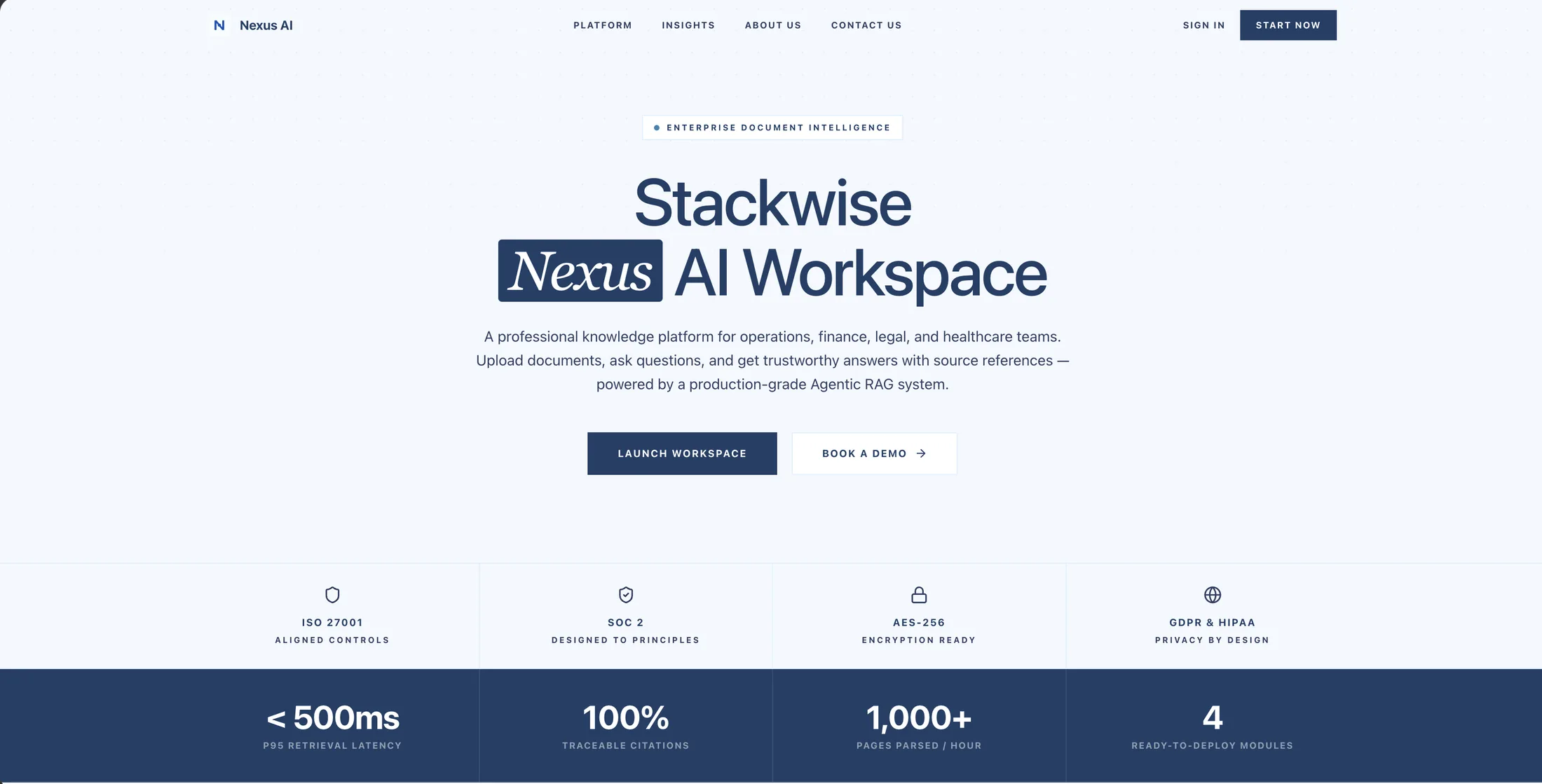
Nexus AI Workspace: agentic RAG with hybrid search — P95 retrieval <500ms*, 100% traceable citations*, 1,000+ pages/hour parse*
Executive summary
- •Problem: teams need trustworthy answers from their own PDFs — standard retrieve-once RAG fails when context is thin.
- •Solution: Docling ingest → OpenSearch hybrid index → LangGraph agent (retrieve/rewrite/grade) → cited answers.
- •Result (product-published*): P95 retrieval <500ms, traceable citations, 1,000+ pages parsed/hour.
The business challenge
Knowledge work depends on contracts, policies, and reports locked in complex PDFs. Naive RAG retrieves once and answers anyway. Buyers need page-level citations, confidence, and an agent that can rewrite/retrieve again when context is insufficient.
- •Wrong answers from thin retrieval context
- •Hours lost hunting clauses across PDFs
- •Inability to audit which page an answer came from
- •Wrapper tools that cannot parse complex tables/layouts
Goals & non-goals
Goals
- •Parse complex PDFs (tables, multi-column) cleanly
- •Hybrid retrieval (BM25 + dense vectors)
- •Agentic loop: evaluate → retrieve/rewrite → grade → answer
- •Every claim traceable to page + excerpt + confidence
Non-goals
- •Training foundation models on customer corpora
- •Answer-without-source modes as default
The solution
Nexus AI Workspace runs an agentic RAG pipeline: Docling parsing, dual indexing in OpenSearch (BM25 + embeddings), LangGraph reasoning agent, and grounded responses with page numbers, quotes, and confidence.
Ingest
Docling parses complex layouts into structured chunks
Index
Hybrid BM25 + sentence-transformer vectors
Reason
LangGraph agent can re-retrieve / rewrite / grade
Answer
Page citations + excerpts + confidence
Modular
Knowledge Retriever can run standalone
Technical architecture
| Layer | Technology | Why | Alternatives |
|---|---|---|---|
| Parsing | Docling | Tables/headers/multi-column fidelity | Naive text extract |
| Search | OpenSearch hybrid | Keyword precision + semantic recall | Vector-only OR keyword-only |
| Agent | LangGraph | Multi-step retrieval decisions | Single-shot RAG |
| Embeddings | Sentence transformers | Dense retrieval quality | Keyword only |
| Trust | Citations + confidence | Auditable answers | Chat without sources |
Implementation path
- 1.PDF ingest + Docling chunking
- 2.Dual index build (BM25 + vectors)
- 3.LangGraph agent graph for retrieve/grade/answer
- 4.Citation packing with page anchors + confidence
Challenges & trade-offs
Complex PDFs
Why hard: Tables/multi-column break naive extractors
Solution: Docling advanced parsing
Trade-off: Heavier ingest CPU vs plain text
Thin context
Why hard: Retrieve-once answers confidently wrong
Solution: Agentic re-retrieve/rewrite/grade loop
Trade-off: Higher latency budget than single-shot
Results & metrics
Labels: WP = website-published · OPS = operational outcome · ARCH = design target
| Metric | Before | After | Source | Label |
|---|---|---|---|---|
| P95 retrieval latency | — | < 500ms* | stackwise.site product page | WP |
| Citation traceability | Uncited chat | 100% claims intended source-traceable* | product page | WP |
| Parse throughput | — | 1,000+ pages/hour* | product page | WP |
| RAG type | Standard retrieve-once | Agentic LangGraph loop | Architecture | OPS |
Value by stakeholder
Technical evaluators
Named stack: Docling, OpenSearch, LangGraph
Risk/compliance
Page-level citations for audit
Ops/knowledge teams
Ask questions across corpora instead of hunting files
Procurement
Performance metrics published for comparison
Planning something similar?
Tell us the stuck flow. We can start with a scoped paid diagnosis — reproduce, investigate, and give written options.