
proposalflow.stackwise.site · AI Product
ProposalFlow AI – RFP Automation
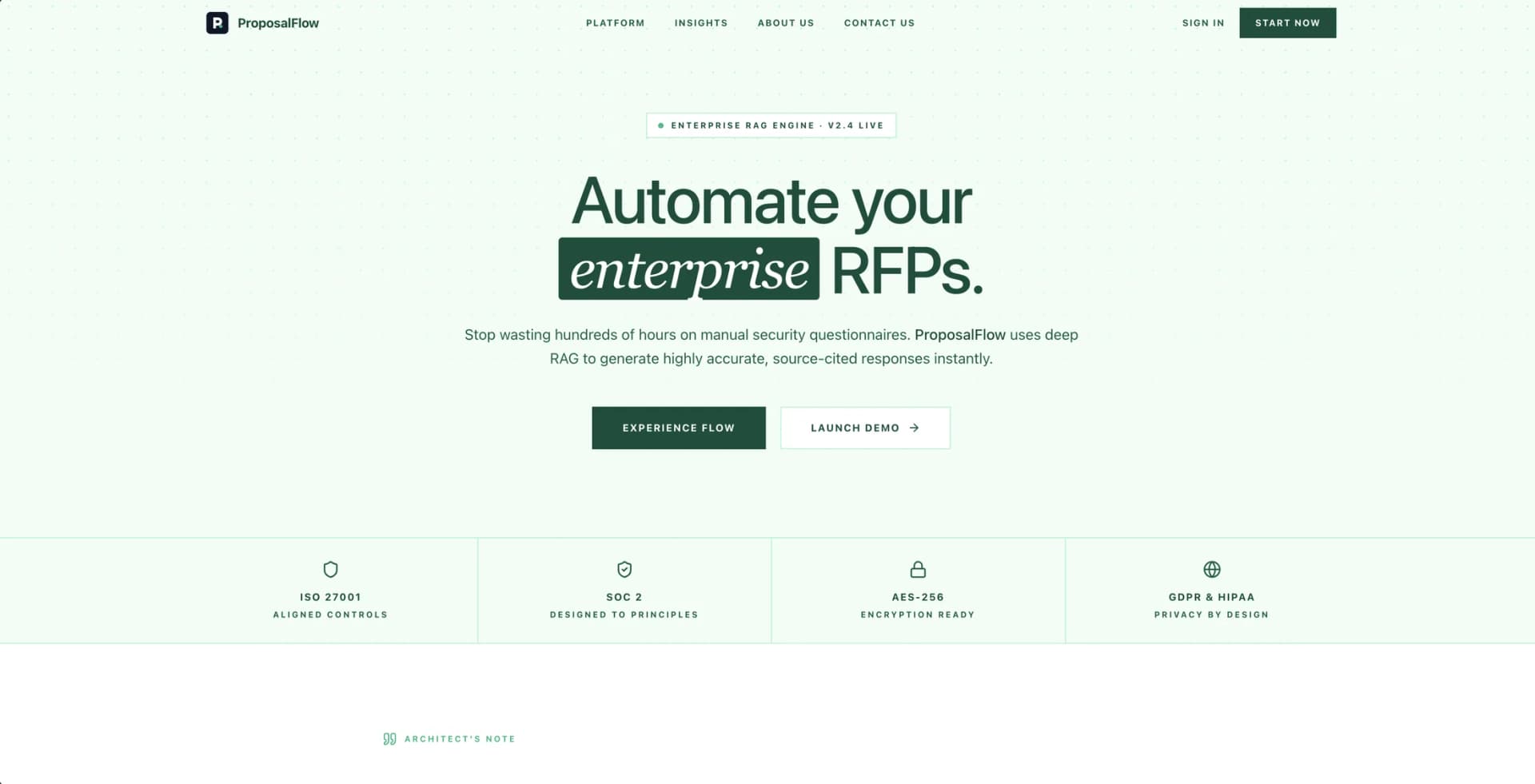
ProposalFlow AI: RAG-drafted, source-cited RFP & security questionnaire answers — parallel synthesis with risk guardrails
Executive summary
- •Problem: RFPs and security questionnaires burn hundreds of hours; copy-paste creates ungrounded risk.
- •Solution: deep RAG over approved libraries with parallel answer synthesis, citations, and risk guardrails.
- •Result: faster first drafts with source-backed answers — built for high-stakes response workflows.
The business challenge
High-stakes questionnaires punish hallucination and outdated claims. Teams waste cycles copying from old decks, producing inconsistent brand voice and answers that cannot be traced to approved source documents.
- •Missed RFP deadlines
- •Inconsistent security answers across deals
- •Principal engineer time burned on questionnaires
- •Compliance risk from invented claims
Goals & non-goals
Goals
- •Draft grounded answers from approved knowledge libraries
- •Parallelize questionnaire item synthesis
- •Keep citations and risk guardrails on every answer
- •Preserve brand alignment
Non-goals
- •Auto-submitting questionnaires without human review
- •Inventing security controls not in the knowledge base
The solution
ProposalFlow uses enterprise RAG to generate source-cited proposal/security answers in parallel, with hallucination controls, semantic indexing of proposal libraries, risk guardrails, and brand alignment.
Deep RAG
Retrieve approved content before drafting
Parallel synthesis
Many questionnaire items at once
Risk guardrails
Reduce unsafe/overclaiming language
Citations
Trace answers to source docs
Brand alignment
Stay on-message with approved voice
Technical architecture
| Layer | Technology | Why | Alternatives |
|---|---|---|---|
| Corpus | Semantic index of proposal/security libs | Answers from approved truth | Oldest Word docs in a folder |
| Generation | Constrained RAG drafting | Lower hallucination risk | Generic LLM chat |
| Workflow | Parallel item processing | Compress calendar time | One-question-at-a-time grind |
| Controls | Risk + brand guardrails | Protect high-stakes claims | Unreviewed free text |
Implementation path
- 1.Ingest approved proposal/security document libraries
- 2.Index + retrieval evaluation on sample questionnaires
- 3.Parallel draft generation with citations
- 4.Human review workflow before customer submission
Challenges & trade-offs
Overclaiming risk
Why hard: Sales pressure vs security truthfulness
Solution: Guardrails + cite-or-refuse behavior
Trade-off: Some items remain manual
Stale content
Why hard: Old answers become wrong after product changes
Solution: Library freshness becomes an ops process
Trade-off: Requires content ownership
Results & metrics
Labels: WP = website-published · OPS = operational outcome · ARCH = design target
| Metric | Before | After | Source | Label |
|---|---|---|---|---|
| Draft cycle time | Manual days/weeks | Parallel AI-assisted first drafts | Product capability | OPS |
| Answer grounding | Copy-paste tribal memory | Source-cited RAG drafts | Architecture | OPS |
| Risk posture | Uncontrolled chat answers | Guardrails + human review path | Product design | OPS |
| Discovery time narrative | — | Overlapping 88%* style claims on related pages | Related product marketing | WP |
Value by stakeholder
Sales engineering
Hours back on questionnaires
Security
Answers tied to approved sources
Proposal managers
Faster first drafts with consistent voice
Technical buyers
RAG architecture they can evaluate
Planning something similar?
Tell us the stuck flow. We can start with a scoped paid diagnosis — reproduce, investigate, and give written options.